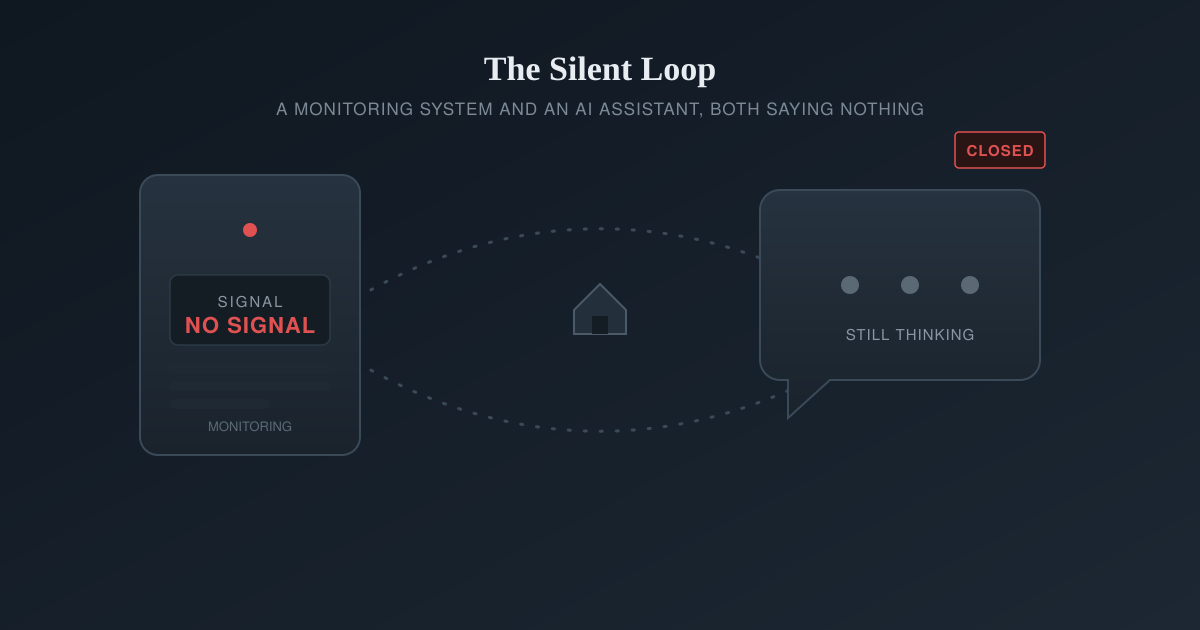
I found out by accident that my house had not been protected in I do not know how long. At least six months. Possibly longer. I still do not have an exact number, and that gap is part of the story.
Not because anything happened. Nothing did, which is exactly the problem. The cellular monitoring box from my national home security monitoring company, the piece of hardware that actually carries the signal to their monitoring center, had failed. Quietly. Completely. For at least six months, my system had been sending zero signals to their monitoring center. No alarms, no test pings, nothing. And in all that time, nobody there noticed, flagged it, or called to tell me my house had gone dark.
Here is the part that made it worse once I understood it. There was a warning on the panel itself, some kind of indicator for a long-range signal issue. I saw it. I did not treat it as a stopping problem, and I can tell you exactly why: I had the company’s app on my phone, and I used it almost every night to arm the system before bed. If the app worked, the system worked. That was the logic, and it felt reasonable at the time. I assumed the app was proof that things were fine, and maybe even that it gave me some redundancy, that if the cellular connection ever had trouble, the internet connection my app was clearly using would carry the load. It did not. The app talked to the panel to let me control it. It was never a second path for the company to monitor it, and it had nothing to do with whether a signal was reaching their monitoring center. Underneath, monitoring ran solely through that one cellular module, no fallback, no failover. A warning light on the panel was the only honest signal I had, and I read right past it because a completely unrelated piece of the system, the one I touched every night, was working fine.
I want to sit with that for a second, because it is the part that should bother you as much as it bothered me. Yes, I saw a warning light and did not chase it down, and I own that. But a monitoring company’s entire value proposition is that they are watching so I do not have to, catching exactly the kind of thing a warning light on a panel is easy to miss on a Tuesday. Mine went silent for at least half a year and the silence itself never triggered anything on their end. Not a text, not an email, not a courtesy call, nothing that said “your panel has been reporting a signal issue, here is what that means.” The one company whose entire job was to notice a failure like this had every opportunity to catch it and did not, and it turns out the safety net I thought I had was a single point of failure the whole time.
Here is what did not fail once during any of this. The billing. Every month, on schedule, the charge landed on my credit card without a single hiccup. A system can go dark for half a year and nobody notices. An invoice, apparently, never has that problem.
I Stopped Waiting for Them to Notice
Once I found the gap, I did not wait around to see if the company would eventually catch up. I rebuilt the guts of the system myself, using a Konnected panel to bridge my existing hardwired sensors into a self-hosted Home Assistant setup running on my Synology. That build is its own project and deserves its own writeup, which I will publish separately. For now, what matters here is this: I built a system I can see inside of, one where I know exactly what path a signal takes and what happens if that path breaks. Their box failed for at least six months and nothing about their system ever surfaced that failure to me. Mine does not get to fail that quietly.
With that done, there was only one thing left. Cancel the service that had been billing me the entire time it was not doing its job.
Ask Me Anything, Just Do Not Ask Me to Act
I logged into my account expecting a cancel button somewhere in the account settings. There was not one I could find. So I did what the account portal pointed me toward and opened the AI chat assistant.
It had questions. A lot of them. Account details, reason for leaving, some variation of “are you sure.” It felt less like a tool trying to process a cancellation and more like a retention script, the kind of scripted probing meant to see if there was some way to salvage the account before letting me go, or at least that is what it seemed to be doing. I answered everything it asked. And after all of that, its conclusion was that it could not cancel my service. I would need to either call in or cancel online.
I want you to notice what just happened. I was already online. I was already, functionally, trying to cancel online, through the tool the company put in front of me for exactly that purpose. And I was not some anonymous visitor poking around a public website. I was logged in and authenticated. It knew who I was, it had just spent several questions confirming who I was. The bot’s own answer was a restatement of the thing I was already doing, dressed up as a solution. I asked it a simple follow-up, which of the two did it actually mean, call or cancel online, since it had just told me both. It said it did not have that information. It could hand me two options but could not tell me which one applied to my own account, an account it had already verified was mine. Then I asked the bigger question: if you cannot actually do anything, why did you just ask me ten questions? It did not have an answer to that one either. Of course it did not. It was never built to have one. It was built to collect information, not to use it.
The Loop Gets a Second Lap
Fine, I thought. Call it is. I dialed in, worked through the phone tree, and landed on the company’s phone-based AI assistant, a cousin of the same system I had just finished talking to online. It could not help either. It transferred me to a department that, I discovered when the call connected, was closed.
So I went back to the web chat. I asked it, reasonably I thought, why it had told me to call a number that would route me to a closed department. Its answer was the most honest thing either AI system said to me the entire day: it did not have access to information about that department’s hours, or whether anyone was even staffing it. It was not being evasive. It genuinely did not know, and had no way to find out.
Read that back. The company built an AI system to sit at the front of its customer service operation, and that system does not know when its own colleagues are at their desks. It can ask you eight questions about your account and your reason for leaving, but it cannot tell you whether the department it is about to send you to is open. Two different AI systems, two different channels, and neither one had the access or the authority to close a single loop.
An AI That Cannot Act Is Just a Longer Hold Queue
Here is the pattern underneath both failures, the monitoring box and the chatbots, and it is the same pattern. Somebody built a system, deployed it, and never gave it the ability to notice or fix the thing it was supposed to be responsible for. The monitoring box had no way to flag its own silence. The AI assistants had no way to check a department’s hours, no authority to process a cancellation, no path to escalate beyond “call this other number” even when that number led nowhere.
If you are running a business and looking at AI to handle customer interactions, sit with this before you deploy anything. An AI system that can gather information but cannot act on it, that cannot even see the basic operational facts a human in that seat would know without thinking, is not saving your customers time, it is adding a layer between them and a real answer and dressing that layer up as a solution. I still have not gotten my account cancelled as of writing this, still caught somewhere between a closed department and a chatbot that does not know it is closed. So here is the question I would put to anyone building or buying one of these systems, and to myself the next time I am tempted to trust a warning light I do not fully understand: does your AI actually have access to the truth and the authority to act on it, or does it just sound like it does?